
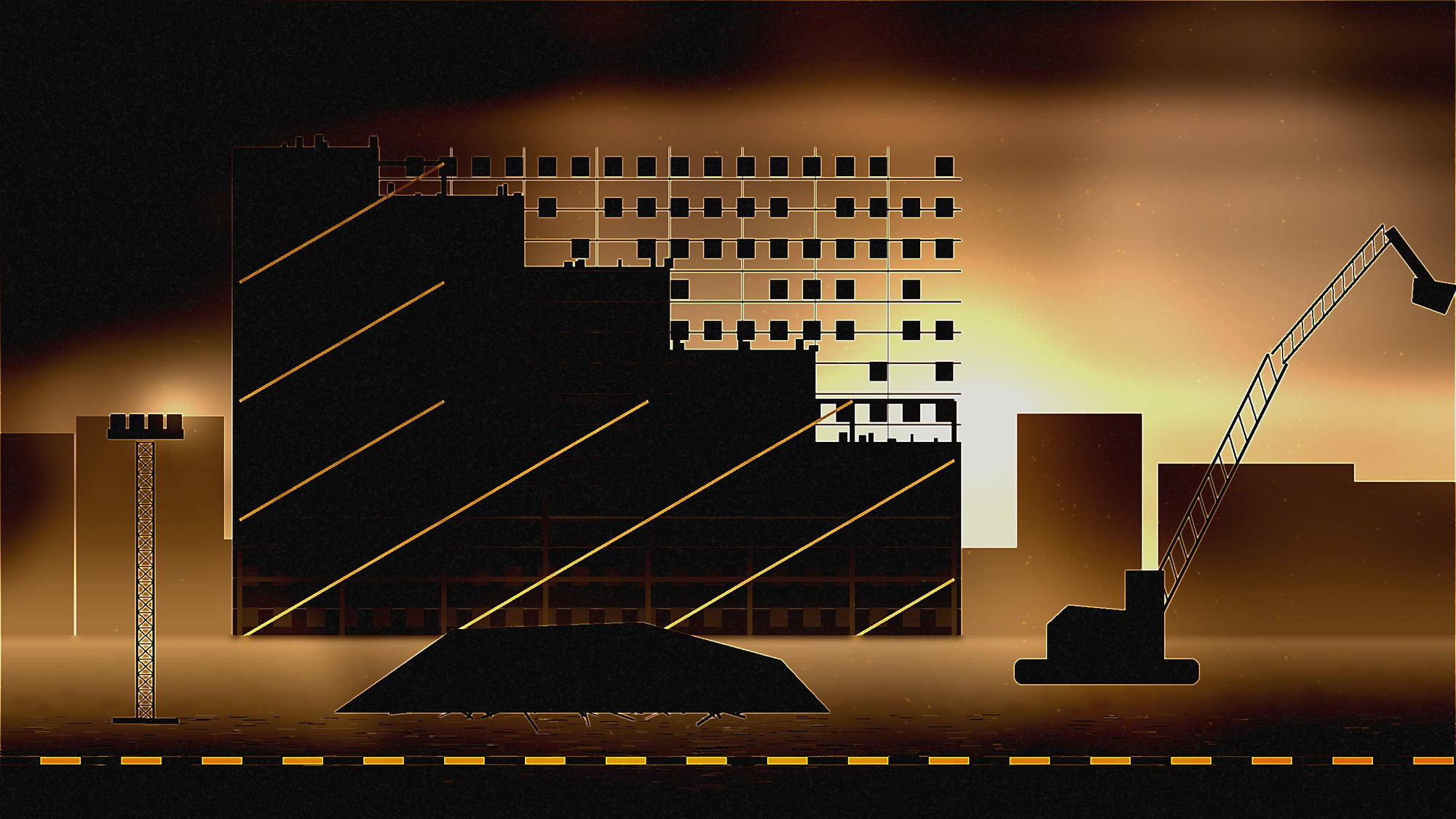
High-reach, mechanical and progressive demolition of industrial buildings, silos, stacks, foundations and heavy frames — engineered for collapse control, exclusion management and adjacent-asset protection.
- Max demolition height
- 65 m by high-reach machine
- Structure types
- Steel frame · RCC · masonry · composite · silo & stack
- Monitoring
- Vibration · noise · dust · adjacent-structure movement
- Concrete processing
- On-site crushing to reusable graded aggregate
The difficulty in structural demolition is rarely bringing a structure down. It is controlling exactly how, exactly when, and exactly where — with a live substation forty metres away, a public road on one boundary and a production building sharing a wall.
DDMS Global approaches every structure as a load-path problem. We model how the structure carries load in its current, deteriorated condition — not as designed — and identify the sequence in which members can be removed without inducing an uncontrolled failure. Where the analysis shows instability mid-sequence, we design and install temporary support before a single member is released.
Exclusion management is treated with the same rigour. Drop zones, machine standing positions, overrun allowances, spotter positions and evacuation routes are drawn, walked and briefed before mobilisation, then re-verified at every sequence change. Dust suppression, vibration monitoring and noise control run continuously where the site boundary demands it.
Scope coverage
- High-reach mechanical demolition to 65 m
- Progressive and top-down structural takedown
- Silo, stack, hopper and bunker demolition
- Reinforced concrete and foundation removal
- Heavy steel frame and gantry demolition
- Confined and party-wall demolition
- Deep foundation and pile cap breaking
- Structural temporary works and propping
Structural appraisal
Assessment of the structure in its actual condition — corrosion, prior modification, undocumented alterations, load already redistributed by deterioration. Older industrial structures rarely match their drawings.
Collapse and sequence engineering
Determination of the demolition sequence, direction of collapse, drop-zone geometry and the point at which temporary support becomes necessary. Machine reach, standing platform bearing capacity and overrun allowance are all fixed here.
Exclusion and protection design
Hard barriers, scaffold protection to retained assets, road and pedestrian management, adjacent-structure monitoring and vibration limits agreed with neighbouring stakeholders.
Soft strip and pre-weakening
Removal of non-structural material, hazardous elements and services. Controlled pre-weakening where the engineered sequence requires it.
Controlled reduction
Progressive mechanical demolition to the engineered sequence with continuous dust suppression, spotter cover and machine-position discipline.
Processing at grade
Arisings are processed at ground level — steel separated, concrete crushed for reuse where specified, rebar recovered and non-recoverable waste segregated.
Foundation removal and clearance
Slab, pile cap and foundation removal to the agreed depth, backfill to specification, and final survey against the handover requirement.
Collapse control by design
Sequence and temporary works are engineered before mobilisation, which is what keeps a controlled takedown controlled at every stage.
Neighbours protected
Vibration, dust and noise are monitored against agreed thresholds, with hard protection to retained assets and adjoining boundaries.
Material recovered at grade
Processing arisings at ground level maximises steel recovery and concrete reuse instead of sending mixed rubble off site.
Programme certainty
Constrained-site demolition is planned with realistic access, laydown and haulage assumptions, so the programme survives contact with the site.
- Max demolition height
- 65 m by high-reach machine
- Structure types
- Steel frame · RCC · masonry · composite · silo & stack
- Monitoring
- Vibration · noise · dust · adjacent-structure movement
- Concrete processing
- On-site crushing to reusable graded aggregate
- Foundation removal
- To agreed depth including pile caps and deep bases
Answered directly by the engineers who deliver this scope.
Our default is mechanical and progressive demolition. Explosive felling is appropriate for a narrow set of structures — tall isolated stacks and certain silo forms with adequate exclusion distance — and where it is genuinely the right method we deliver it through licensed specialist partners under our overall programme control.
Closer than most sites assume, but the answer is set by engineering rather than a rule of thumb. Working within a few metres of live plant is routine with hard protection, top-down sequencing, reduced-energy methods and continuous movement monitoring. We define the achievable clearance during the structural appraisal.
Through a combination of atomised misting at the work front, water suppression on the machine attachment, damping of arisings during processing, wheel washing on egress and continuous boundary monitoring against agreed limits.
Frequently, yes. Where the arisings are clean and the redevelopment programme can accept it, we crush concrete on site to a graded aggregate suitable for piling mats, haul roads or backfill. It removes haulage movements and reduces imported fill.
That depends on the agreed end state. We can remove to slab level, remove slab and foundations to a defined depth, or take out deep structure including pile caps and basements, backfilling and compacting to specification and confirming with a final survey.
Talk to us about structural demolition.
Send the asset, the constraint and the date. We will come back with a method and a realistic programme before anyone discusses price.